
Who Is Your FYP Really For?
Your social media feed may look and feel like it is designed with your interests, values, goals, and tastes in mind. On certain platforms it may literally be called an FYP, or For You Page. But have you ever stopped to ask yourself why something you are using for free is working so hard to cater to you?
Who Are Social Media Platforms Really Built For?
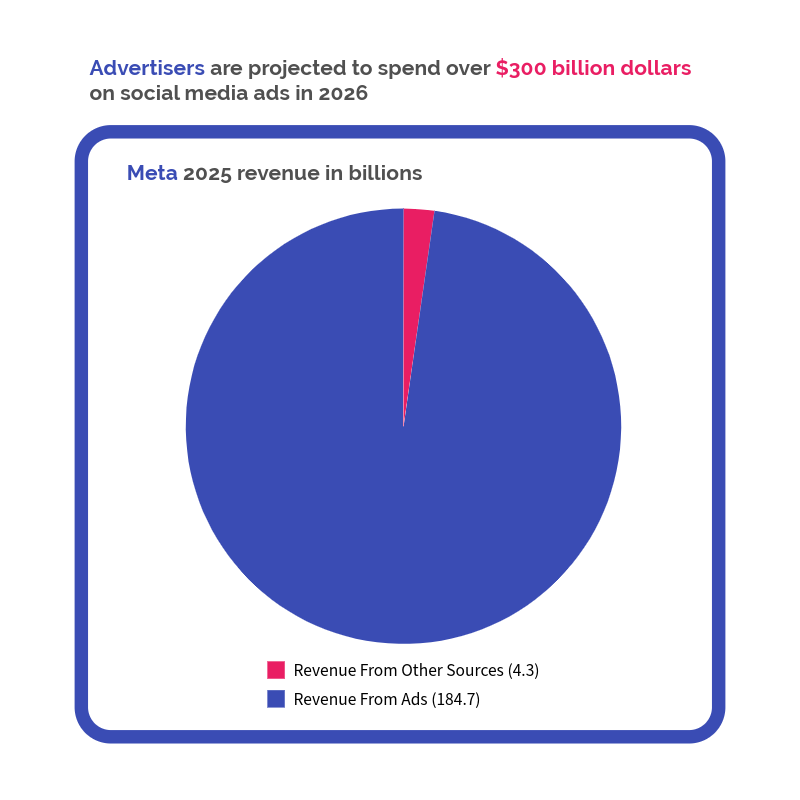
The answer becomes clear when you follow the money. In 2026, advertisers are predicted to spend over $300 billion on social media advertising. Even companies like Meta, which has diversified into other areas of tech like Llama, Oculus, RayBan Meta Glasses, paid verification models, and in-app purchases, are still making the vast majority of their profits from ad revenue. Meta’s revenue from all other sources ($4.3 billion) is a drop in the bucket compared to the $184.7 billion they made from ads in 2025 alone.
Why Is My FYP So Personalized
Ultimately, social media platforms are designed to deliver results that keep companies spending on ads. That requires a consistent base of engaged users who are not only consuming content but also in a buying mindset for what their advertisers are selling.
Cue “The Algorithm.” In a social media context, an algorithm is a set of instructions a platform uses to guess what you’ll want to see next and what will keep you watching. They are designed to prioritize what keeps you engaged and reacting and not necessarily thinking.
It prioritizes:
- Feeding you ads you are likely to respond to
- Keeping you engaged on the platform
- To inform advertisers and creators what gets reactions and converts into sales/followers
What’s the Downside?
While platforms can program in safeguards to detect misinformation, AI content, scams, and other unwanted content, machines and AI have little to no regard for truth, reality, context, or morals. The algorithm doesn’t care why you reacted, only that you did.
When the goal is to give you more of the content you are likely to react to and engage with, what often ends up getting prioritized is content that elicits an emotional reaction, like extreme opinions, clickbait, emotional content, and fast-moving trends over facts.

This practice isn’t new or exclusive to social media. It’s essentially a modernization of the concept of “Yellow Journalism” that newspaper publishers were criticised for over a century ago. Similarities include:
- Extreme opinions (rage bait/click bait)
- Emotional content (extreme, exaggerated, or graphic images and video)
- Isolated or out of context information
- Content that reinforces your existing beliefs
- Trends that move fast, not facts that last
Who Benefits from Platform Algorithms?
While the companies that run the platforms and the advertisers are the obvious answers, there are many people and groups who benefit from the platform’s design, for good, bad, or in between. The main beneficiaries include:
Influencers/Content Creators: People who understand how the platform works and are willing to put in time and effort can monetize their efforts to varying levels of success.
Scammers: Fraud, phishing, and other scams thrive in an environment created to make you click before you think.
Influence Operators: Influence operators exist to sway opinions, motives, and actions to benefit a particular agenda. They can be a person, group, organization, or automated system (bot) and operate by manipulating public opinion, behavior, or decision-making.
Ethical Influence Operations include things like honest marketing, awareness campaigns, public health initiatives, and crisis response. Non-Ethical Influence Operations often spread misinformation, disinformation, or propaganda and may look like scams, bot networks, election interference, PsyOps, astroturfing, or radicalization.
What Are the Negative Effects of Social Media Use?
Platforms, content creators, and bad actors build and rely on an ecosystem of emotional reactions rather than rational responses. Algorithms feed users emotions and validation to keep us hooked, creating habits and behavior patterns that don’t turn off when we log out. They can manifest as:
- Emotional ups and downs
- Comparison trap/pressure to be perfect
- Fear of missing out (FOMO)
- Self-doubt
- Performative posting
- Acting out of character
- Constant need for feedback and validation
- Getting stuck in an echo chamber with a limited perspective of other viewpoints
How Can I Take Control of My Social Media?
The good news is that the same way the platform controls what you see can be the key to taking back control. By understanding how the platform works, you can use the algorithm to your benefit and curate your feed. It just takes being intentional about how you consume and engage with content.
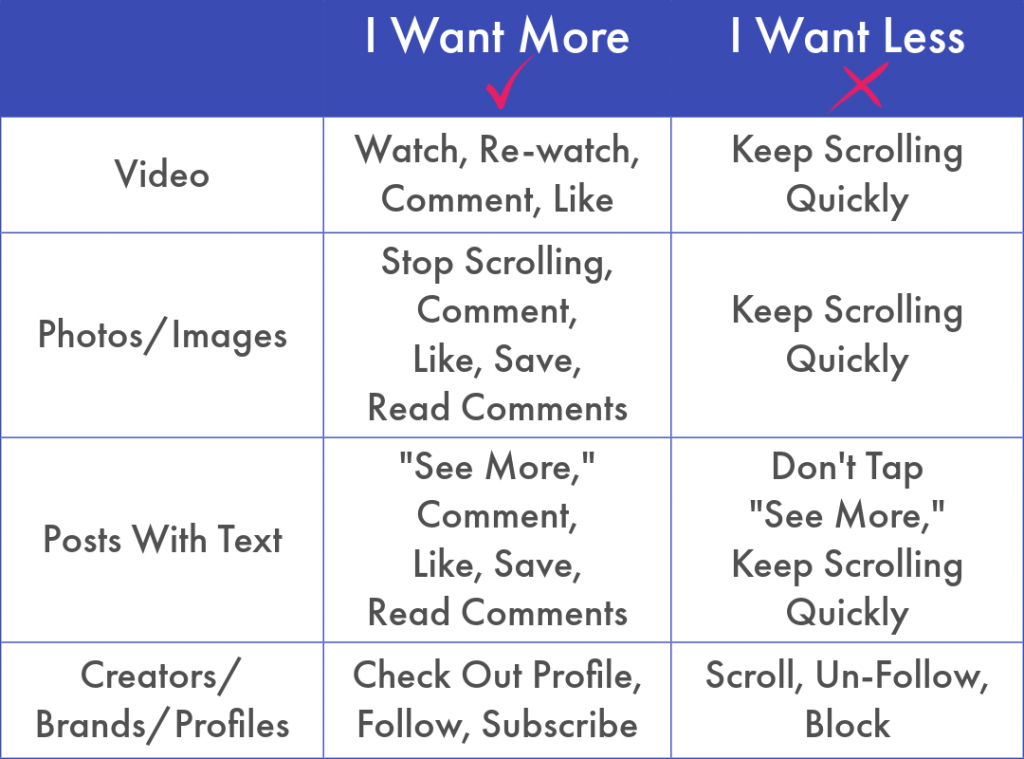
The algorithm uses your behavior to learn what to show you:
- Watch time, replays, pauses
- Likes, comments, shares, follows, saves
- Scrolling speed
- Clicks & profile taps
- Silence & inaction still teach
If you want to own your feed, as you are scrolling, also make sure to:
- Curate your feed using the chart
- Pause before reacting
- Check the source
- Seek out and engage with what you want more of
- Notice your feelings when making a decision about content
- Set personal boundaries around social media
- Diversify perspectives
- Don’t engage/share if you aren’t sure
Own Your Social Media Feed
Your FYP may feel personal, but it is ultimately powered by patterns, predictions, and profit. Social media platforms are designed to get and keep your attention, influence your behavior, and encourage engagement in order to fuel revenue.
That doesn’t mean social media is inherently bad; in fact, it can be a tool used for tremendous good. It means that, to make social media work for you, you have to change how you think about it and the very habits it is designed to instill. By shifting your mindset and being intentional about how you scroll, you can transform your FYP into something truly shaped by you, into something that reflects your values, goals, tastes, and curiosity and gives you a more diverse perspective of the world.